Limits of In-Order Execution
September 13, 202626 min readadvanced
The five-stage pipeline of Chapter 29 and the deeper in-order variants of Chapter 32 share a strict discipline. Instructions move through the pipeline in the order the program writes them. When an older…
The five-stage pipeline of Chapter 29 and the deeper in-order variants of Chapter 32 share a strict discipline. Instructions move through the pipeline in the order the program writes them. When an older instruction stalls, every younger instruction behind it stalls with it, even if their own operands are ready and their own functional units are idle. The pipeline’s throughput is pinned to whichever instruction happens to be at the front of the queue.
In Part IV the cache hierarchy was shown to deliver an effective memory-access time of a few cycles on the average hit but tens to hundreds of cycles on a miss. A load that misses in L1 spends roughly ten cycles waiting for the L2 response. A load that misses all the way to DRAM spends three hundred cycles or more. In an in-order pipeline, every one of those cycles is a cycle in which the entire pipeline behind the load is frozen. The independent arithmetic, the independent loads, the independent stores that the program also contains all sit idle, blocked by a single instruction that happens to be earliest in program order.
This chapter develops the quantitative argument for why the in-order discipline becomes the bottleneck once the cache miss rate, the multi-cycle functional-unit count, and the issue width exceed modest values. It revisits the load-use stall introduced in Chapter 30 and shows how the cost scales with miss penalty. It surveys the structural hazards that arise in superscalar in-order designs. It walks through three modern in-order cores (ARM Cortex-A53, SiFive S76, and the historical Intel Atom Bonnell) to show where each hits the diminishing-returns wall. It closes by framing out-of-order execution as the direct response to those limits, motivating the algorithms developed across the next four chapters.
01.The Single-Stall Multiplier
The in-order pipeline’s defining property is that one stalled instruction stalls every instruction behind it. To put a number on the cost, consider a five-stage pipeline running an instruction mix in which one instruction out of every twenty suffers an L1 miss that takes ten cycles to resolve. The miss rate at the load level is higher than one in twenty, because not every instruction is a load. A typical integer mix has around 25 percent loads and 10 percent stores, so a one-in-twenty overall miss rate corresponds to a one-in-five miss rate on loads. Modern L1 caches achieve miss rates below 5 percent on SPEC integer workloads, so the one-in-five figure used here is deliberately pessimistic, chosen to keep the stall mechanism visible in round numbers.
Without misses the pipeline runs at CPI 1.0. Each ten-cycle miss adds ten stall cycles to the pipeline. The miss contributes to the average cycles per instruction. The effective CPI rises to 1.5. The pipeline’s effective throughput is therefore two-thirds of its peak rate, lost entirely because the in-order discipline cannot bypass the missing load.
Suppose now that the workload contains independent work that could profitably overlap with the miss. A typical SPECint trace contains five to ten instructions of independent work within twenty instructions of an L1 miss. None of that independent work can run in an in-order pipeline because the missing load sits in front of it. If those five-to-ten cycles of independent work could be issued during the miss, the effective CPI would fall back toward 1.0. The whole gap between 1.0 and 1.5 is the architect’s payoff for going out-of-order.
The argument generalizes beyond cache misses. Any operation whose latency exceeds the average issue interval imposes the same penalty. Integer multiply on a typical in-order core takes three to five cycles. Integer divide takes ten to forty cycles. Floating-point divide takes twenty to fifty. A non-pipelined divider in an in-order pipeline stalls every subsequent instruction for its entire latency, even when none of those instructions consume the quotient.
02.Load-Use Stalls Dominate
Chapter 30 introduced the load-use hazard and quantified the one-cycle bubble per back-to-back load-then-use pair on the five-stage pipeline. Compilers schedule around the hazard by separating the load from its consumer with an unrelated instruction. On classic RISC benchmarks the compiler succeeds roughly 70 to 80 percent of the time. The remaining 20 to 30 percent of load-use pairs hit the bubble.
The bubble grows when the load misses in the L1 cache. A hit costs one cycle in the original five-stage pipeline. A miss that resolves from the L2 cache costs roughly ten cycles. A miss that resolves from DRAM costs roughly three hundred cycles. In an in-order pipeline these are not bubbles, they are full pipeline stalls. The penalty scales linearly with the miss latency.
Consider the loop body
LW x1, 0(x10)
ADD x2, x1, x3
SW x2, 0(x11)
ADDI x10, x10, 4
ADDI x11, x11, 4
BNE x10, x12, loop
Six instructions. The load on line one produces x1, the add on line two consumes x1. If LW hits the L1 and the compiler has scheduled an instruction between the load and the add, the loop runs at CPI close to 1.0. If LW misses to the L2, the second instruction stalls for ten cycles. The store on line three needs x2 and would wait for the add in any case, but the remaining three instructions, which share no dependence with the missing load, stall behind the add as well.
The cost per miss is therefore not just the miss latency. It is the miss latency multiplied by the number of independent instructions that could have run in parallel but were trapped by the in-order discipline. In the loop above, three independent instructions sit in the queue, none of them able to make progress until the missing load returns.
Table 1. Load-use stall scaling across the cache hierarchy on a 5-stage in-order pipeline
| Hit level | Latency (cycles) | Stall bubbles | Trapped independent insns |
|---|---|---|---|
| L1 hit, scheduled | 1 | 0 | — |
| L1 hit, unscheduled | 1 | 1 | 0 to 1 |
| L2 hit | 10 | 9 | 4 to 8 |
| L3 hit | 35 | 34 | 15 to 30 |
| DRAM | 300 | 299 | 150 to 250 |
The third column counts the bubble cycles that the pipeline inserts in the worst case (the case in which the compiler could not find any unrelated instruction to fill the slot). The fourth column estimates the count of independent instructions that a wider, out-of-order machine could have issued during the wait. The product of cache miss rate, miss penalty, and the count in the fourth column is the upper bound on the speedup the architect can extract by going out-of-order.
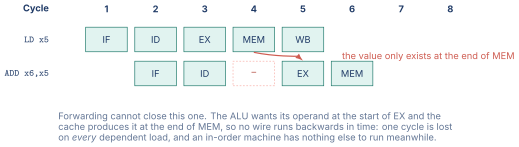
Figure 1 shows the cycle that cannot be forwarded away.
03.Structural Hazards on Shared Functional Units
The single-issue five-stage pipeline has one ALU, one shifter, and one memory port. There is no structural hazard between two arithmetic instructions, because each one passes through its functional unit on its own cycle. Once the pipeline widens to issue two or more instructions per cycle, the picture changes.
A two-wide in-order pipeline (the canonical example is the ARM Cortex-A53) has two pipelines side by side, often called Pipe 0 and Pipe 1. Pipe 0 is symmetric and can execute any instruction. Pipe 1 is asymmetric and lacks the divider, the multiplier, or the load-store unit, depending on the implementation. When two instructions arrive at the dispatch stage and both need the resource that only Pipe 0 has, the second one stalls. The pipeline drops from issuing two instructions per cycle to issuing one. The throughput is halved for the duration of the structural conflict.
The table below estimates the rate at which structural hazards arise on a generic two-wide in-order design with asymmetric pipes. The numbers come from the SPEC CPU2017 integer mix as published in vendor disclosures. The share of multiplies, divides, and floating-point operations is small in absolute terms but enough to noticeably reduce the realized issue rate.
Table 2. Estimated structural-hazard rate on a 2-wide in-order design with one asymmetric pipe
| Operation class | Fraction of instructions | Pipe-0 only |
|---|---|---|
| Integer ALU | 0.42 | no |
| Loads | 0.25 | no |
| Stores | 0.10 | no |
| Branches | 0.15 | no |
| Integer multiply | 0.04 | yes |
| Integer divide | 0.005 | yes |
| FP add/mul | 0.03 | yes |
The Pipe-0-only fraction sums to about 7.5 percent. When two adjacent instructions in the dispatch queue both fall into this group, the second one stalls for one cycle. The probability is small but the cumulative cost over a long program is measurable. On SPEC integer the structural-hazard penalty on Cortex-A53 amounts to roughly 4 to 6 percent of total cycles. On SPEC floating-point, where the floating-point operations cluster, it rises to 8 to 12 percent.
Out-of-order execution sidesteps the structural problem by decoupling dispatch from issue. The dispatcher places instructions into reservation stations, the issue logic chooses which instructions in the stations have ready operands and free functional units, and the in-program-order constraint is lifted within the execution stage. A young multiply does not block a young add even if both ended up in the same dispatch window.
04.Superscalar In-Order in Practice
The ARM Cortex-A53, the SiFive S76, and the historical Intel Atom Bonnell illustrate the shape of the in-order superscalar curve. All three are two-wide. Each widens the fetch and dispatch path over a scalar design, adds duplicated functional units, and yet plateaus at an IPC well below its width. The gap between issue width and realized IPC is the unspent ILP that in-order execution leaves on the table.
That all three settled on two-wide is itself the point. Two is where the in-order superscalar market converged, because the third slot costs dispatch logic and a third set of functional units while returning very little on real code, for the reasons the structural-hazard section gave.
ARM Cortex-A53
The Cortex-A53 is the workhorse little core in many ARM big.LITTLE configurations. It is an in-order, dual-issue, eight-stage pipeline. The two pipes are asymmetric, with one of them hosting the multiplier and the divider. Branch prediction is a two-level adaptive predictor with a small branch target buffer. The L1 instruction and data caches are 32 KiB each.
Published Hot Chips disclosures place its SPEC CPU2006 integer score around 0.7 to 0.9 IPC depending on workload. The width allows two instructions per cycle, so the realized IPC is well below half of peak. Three measurable stall sources account for part of the gap.
-
Load-use stalls when the compiler cannot schedule into the load delay slot. Roughly 6 to 8 percent of cycles.
-
L1 miss penalties (about 9 cycles to L2) that block the entire pipeline. Roughly 8 to 12 percent of cycles.
-
Structural hazards when two adjacent instructions both need the asymmetric pipe. Roughly 4 to 6 percent of cycles.
Adding the three sources gives 18 to 26 percent of cycles lost to outright stalls, which is well short of the roughly 57 percent shortfall implied by a realized 0.85 IPC against a 2.0 peak. The rest of the gap is not stall at all. It is the far more common case in which the pipeline advances but issues only one instruction, because the next two instructions in program order depend on one another, or map to the same pipe, or sit on opposite sides of a taken branch. The Cortex-A53 is not slow in absolute terms (it powers billions of devices), but its peak-to-realized ratio is roughly 0.4. The same workload on a Cortex-A55 successor, which retains the in-order discipline but tightens load-use forwarding and adds a small structural queue, lifts realized IPC by about 15 percent. Going to the out-of-order Cortex-A78 lifts realized IPC by another factor of two on the same workloads, because the out-of-order issue window absorbs the L1 misses that froze the A53.
SiFive S76
The SiFive S76 is a dual-issue in-order RISC-V core targeted at high-performance embedded workloads. Its pipeline is eight stages, with a 32 KiB L1 instruction cache and a 32 KiB L1 data cache. The two pipes are asymmetric in the same way as the Cortex-A53’s, with loads, stores and the multiplier confined to one of them.
The published SPEC CPU2006 IPC for the S76 sits around 1.1 to 1.3. The width permits two instructions per cycle, so the realized fraction is 0.55 to 0.65. The dominant loss is the same load-use and L1-miss combination as on the Cortex-A53.
The comparison with the Cortex-A53 is the useful one, because the two cores have the same width and the same pipeline depth and still differ by roughly 0.4 IPC. None of that gap comes from issue width. It comes from the branch predictor, the memory system, and how early the pipeline resolves a load-use dependence. At a fixed width, those are the levers that remain, and they are the levers an in-order design runs out of first.
Intel Atom Bonnell
The original Intel Atom (codename Bonnell, 2008) is the canonical example of an x86 in-order superscalar that hit the wall hard. It was a two-wide, sixteen-stage in-order pipeline targeting low-power netbook and mobile workloads. The pipeline length came from the x86 decode complexity rather than from deeper integer or memory work. Branch resolution sat at stage 13, so each misprediction cost twelve cycles.
Bonnell’s SPECint score per gigahertz came in around 0.7, roughly half that of the contemporary out-of-order Core 2 at 1.4 to 1.6 per gigahertz. The gap was not a clock-frequency gap, both ran in the 1.6 to 2.0 GHz range. The gap was almost entirely the in-order discipline failing to overlap memory latency. Intel’s response was Silvermont (2013), the first out-of-order Atom. Silvermont preserved the low-power target but moved to out-of-order execution with a 32-entry reorder buffer. Realized IPC on SPECint roughly doubled at the same clock, because the out-of-order window finally let the core run during L1 misses.
05.Amdahl on Instruction-Level Parallelism
Chapter 2 introduced Amdahl’s law as the upper bound on the speedup any optimization can achieve. The same law applies to instruction-level parallelism. Let be the fraction of dynamic instructions that can in principle run in parallel, and let be the issue width of the out-of-order machine. The speedup over a single-issue baseline is bounded by
If (half of the program is serial, half is parallel) and , the speedup is . Widening to gives . Widening to gives . Doubling the issue width from four to eight buys 0.18 of additional speedup. Going all the way to infinite width buys only another 0.22. The remaining serial 50 percent caps the speedup at 2.
The in-order machine’s parallel fraction is lower than the out-of-order machine’s, because the in-order discipline artificially serializes instructions that are independent in dataflow but trapped behind a stall. Measured ILP windows on SPEC integer hover around to for the best compilers and aggressive scheduling. The out-of-order window recovers an additional to of by tolerating cache misses. Even with that recovery, the program’s serial critical path through true RAW dependences imposes a ceiling.
06.Why Compilers Do Not Solve the Problem
A natural counterargument is that a sufficiently aggressive compiler could schedule around every stall. The compiler sees the entire program statically, knows the latency of each operation, and can rearrange independent instructions to fill delay slots. The early MIPS R-series CPUs leaned heavily on this argument and exposed the branch delay slot and the load delay slot directly in the ISA.
The compiler’s argument fails for three reasons that are structural rather than incidental.
First, the cache miss latency is not a property of the instruction, it is a property of the memory access pattern. The compiler cannot know in general whether a load will hit or miss. Profile-guided optimization can predict it for the training data set but not for arbitrary inputs. A load that hits 99 percent of the time on the training data may miss 50 percent of the time on a customer’s actual workload, and the compiler’s schedule for the hit case turns into a stall storm on the miss case.
Second, the branch direction is dynamic. The compiler can arrange code so that the predicted-taken side is the fast path, but the actual branch outcome depends on data values that the compiler cannot see. A mispredicted branch in an in-order pipeline costs the depth-of-resolution number of cycles regardless of compiler scheduling.
Third, the compiler’s scheduling window is bounded by the basic-block boundary in many cases. Software pipelining and trace scheduling extend the window across basic blocks at the cost of code bloat and dependence-tracking complexity. The compiler can in principle expand the window arbitrarily wide, but the bookkeeping grows quadratically and the schedule becomes brittle under input variation. Modern compilers typically schedule across at most a few hundred instructions. The out-of-order machine’s window of two hundred to six hundred in-flight instructions is comparable in size, but dynamic, which lets it adapt to input variation.
07.The Motivation for Out-of-Order Execution
Pulling the threads together, the in-order pipeline hits a hard ceiling because three independent forces conspire against it. Cache misses freeze the pipeline for tens to hundreds of cycles. Long-latency arithmetic units block all subsequent work. The asymmetric functional-unit problem reduces the realized issue rate in superscalar designs. Compilers help but cannot eliminate any of the three.
The out-of-order machine attacks the first two forces directly by issuing instructions in dataflow order. A load that misses in the L1 cache no longer blocks the pipeline. The hardware finds independent instructions further down the program and issues them while the miss resolves. The third force is attacked structurally by replicating functional units and letting the issue logic match each ready instruction to the right unit.
The remaining chapters of Part V build the out-of-order machine piece by piece. Chapter 50 presents Tomasulo’s algorithm, the 1967 IBM design that introduced reservation stations and the common data bus and that remains the conceptual backbone of every modern out-of-order core. Chapter 51 develops register renaming, the technique that decouples the architectural register namespace from the physical register file and eliminates WAR and WAW hazards. Chapter 52 introduces the reorder buffer, the hardware structure that maintains in-order retirement even when execution is out-of-order, and that delivers precise exceptions in the face of arbitrary speculation. Chapter 53 develops the issue queue, the scheduler that picks ready instructions out of the in-flight window, and surveys the wakeup-select critical path that dominates the design.
Subsequent chapters in Part V handle branch prediction at scale, speculative execution and recovery, memory ordering in out-of-order pipelines, and the modern microarchitectures that combine all of these techniques. The unifying thread is that every mechanism in Part V exists to lift one of the three in-order ceilings established in this chapter.